
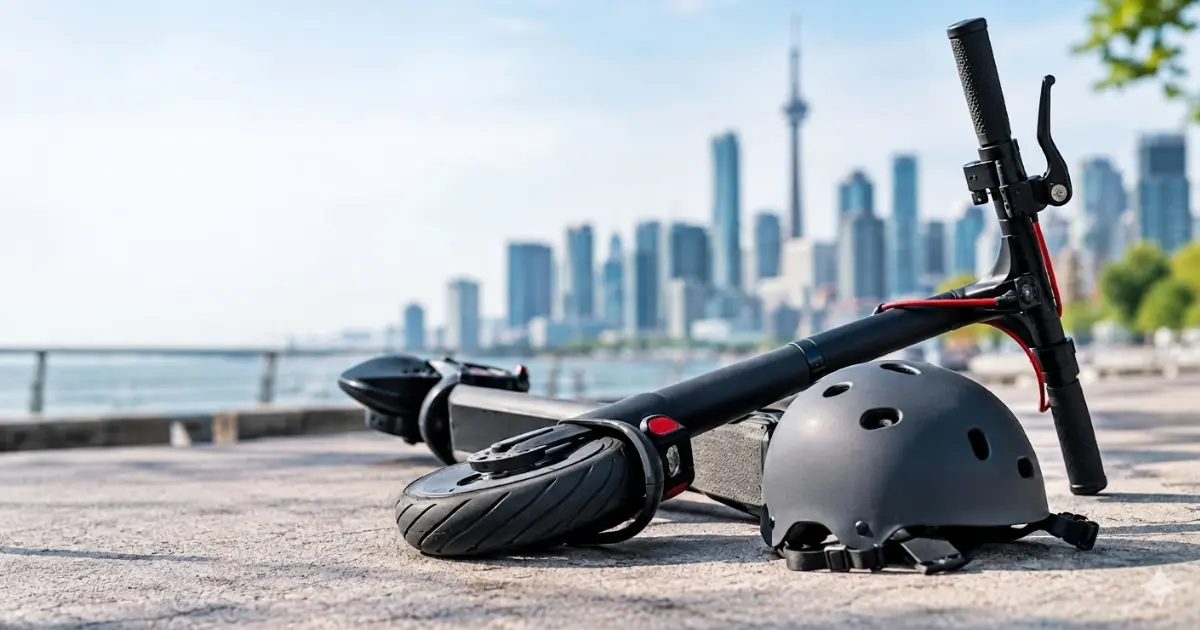
Ontario’s E-Scooter Pilot Project and Municipal Rules
E-scooters have permeated Ontario society and are routinely seen in all major cities and towns. As a personal injury lawyer, we get involved when things go bad with the e-scooter, and there is an accident where someone is injured.
E-scooters were essentially legalized by the Ontario government in 2020, with a pilot project, that has been extended for a 10 year period. The Ontario government decided what the definition of e-scooter would be and left it to the municipalities to opt in and allow them to be operated in their jurisdictions. Currently, there are only approximately 20 municipalities out of 400 that have opted in and permit e-scooters to be operated on public property including roads. Notably, Toronto has not opted in and e-scooters are not permitted on public property and roads.
The legislation prohibits anyone under 16 from operating an e-scooter and anyone under 18 must wear a helmet.
What Qualifies as a Legal E-Scooter in Ontario?
An e-scooter is defined in the provincial legislation as having no more than 500 watts of power and a top speed of 24 km/hr. If the e-scooter has more wattage and/or speed than permitted, it is no longer an e-scooter permitted by legislation and is considered a motor vehicle. This means that the operator must have a drivers license and the e-scooter must have insurance.
The Legal Risks of Illegal and Overpowered E-Scooters
There are a vast amount of e-scooters that are being sold in Ontario that exceed the limits in the legislation, meaning that they have more than 500 watts of power and exceed 24 km/hr. This is a huge problem as people do not understand that if they buy one that they are not permitted to ride them on the roads or sidewalks. They could only be operated on private property.
What Happens When an Uninsured E-Scooter Is Involved in an Accident?
So what would happen to a 15 year old who’s parents bought him an e-scooter that has 1000 watts of power and maximum speed of 60 km/hr, who rides the e-scooter to and from school and around his neighborhood and is unfortunately struck by a drunk driver causing life altering and significant injuries? The answer is shocking. The law would recognize the e-scooter as a motor vehicle, which would require a drivers license and automobile insurance. Therefore, the police could and would likely charge the boy for driving a motor vehicle without a drivers license and charge the parents for failing to insure it under the Compulsory Automobile Insurance Act. This may sound bad enough, but even worse the boy would lose his right to sue the at fault drunk driver given that our law takes away that right if you are driving a motor vehicle without insurance. This is an absolute disaster as the boy did nothing wrong and was critically injured by the drunk driver.
E-Scooter Sellers and the Need for Greater Regulation
The problem is created by a litany of sellers, both on line and bricks and mortar, providing e-scooters to the marketplace that are not legal and will take away significant rights and expose people to charges. The provincial government needs to ensure that e-scooters for sale in Ontario comply with the legislation as we now have a flood of them in the marketplace being sold every day. As injury lawyers we are seeing accidents involving e-bikes and e-scooters routinely and the problems surrounding them are playing out daily.
Written by David Himelfarb